Why bother?
Why devote time and energy to taking notes, writing down ideas, interacting with them, sharing them, revisiting them?
In my last post, I showed you what my “digital mind” looks like: 500+ notes linked together by 700+ connections into a network, a “web of notes”. The visual looks cool, it provides insight, but it’s not the reason I bother.
The litmus test, for me, is this: “Does it make my life better?” I believe that my web of notes does – and not by accident.
I’ve been taking notes for decades. I hold strong opinions about why I take notes and how I use them. I know what works for me, what doesn’t, and why.
Before you adopt any notes system, or build your own, I believe you need a strong point of view on your purpose. Here’s mine – I call it my manifesto.
Why It Matters
- Ideas get lost. And a good idea is a terrible thing to waste. If you can’t find or remember it, you can’t act on it.
- Writing clarifies thinking. Writing is thinking. A web of notes is a workspace where you can draft, edit, combine, and distill.
- Notes provide context. They are your trail of breadcrumbs when you revive a project or topic weeks, months, or even years later.
- Notes need other notes. The more connections between them, the more valuable they are.
Purpose: What a Web of Notes Is For
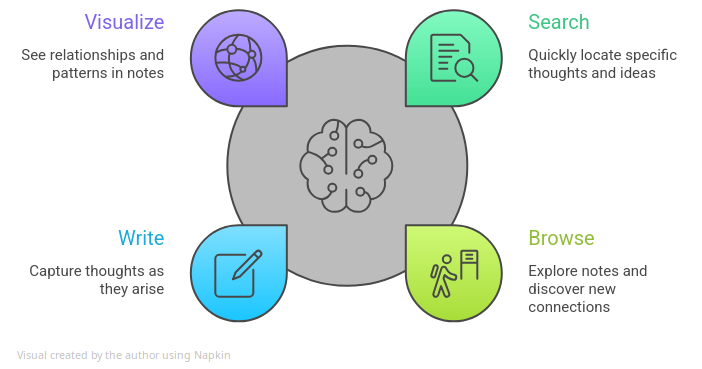
My web of notes lets me interact with my thoughts and ideas as a collection, not as scattered files lost in a wilderness of folders. My web of notes lets me:
- Search: Find what I’ve thought, written, or seen.
- Browse: Read, wander around, and make connections.
- Write: Capture thoughts when I have them.
- Visualize: See the connections, clusters, patterns, and history.
Manifesto: My Musts and Must Nots
My web of notes…
| Must | Must Not |
|---|---|
| Conform to me and how I work | Force a process on me |
| Support my “real work” | Create more work |
| Work simply, flexibly | Introduce complexity, chaos |
| Be text-readable | Use proprietary formats |
| Use only FOSS tools1 | Use proprietary tools or processes |
| Reside locally, under my control | Be controlled/used by others |
| Promote connection | Produce isolated fragments |
| Want to use it daily | Dislike or avoid it |
I can summarize my reasons for my “Musts” and “Must Nots” very briefly:
- If it’s not low-friction, I won’t use it.
- My ideas are not someone else’s product.
- Lock-in is not an option. My notes can’t die because some tool dies.
These “Must/Must Not” constraints are self-imposed. I think they actually clarify and simplify design choices for me.
Wrap-Up
This manifesto isn’t a design document or a blueprint. It’s my position. It’s where I stand.
My web of notes has to fit me: how I think, write, and work. That’s why I keep it local, text-based, and under my control.
You may make different choices. You should. But be deliberate. Write your own manifesto. You’ll be glad you did.
Next time: We’ll look at the tools and methods I use every day to make my web of notes work for me.
FOSS is Free and Open Source Software ↩︎