The winds howled that evening, approaching 50 miles per hour. Based on past experience, I knew that could mean trouble. As Caroline and I drove home from dinner at our favorite restaurant, we saw tree debris everywhere. Then, less than a quarter mile from our house, we were stymied: a large tree had fallen, completely blocking the road. We reversed course and circled around to try from the other direction, but another tree had fallen on that side as well.
Double Dog Drat!
Fortunately, this one was smaller. We could move it just enough to squeeze by. Whew!
Relieved to be home, we settled in to watch a movie. But then, the power blinked hard. Then again. Then again … and it didn’t come back. Bummer! But, I needed to shift into “outage mode”, so I:
- rolled out our Jackery backup generator,
- pulled out our extension cords, and
- plugged in the essentials.
It’s surprising how much better an outage feels when you can keep a few lights on and watch a movie. But there was a bigger issue looming…
Why It Matters
We have an electric heat pump. So when we lose power, we also lose heating.
When we lose heating during a cold-weather outage, the temperature inside the house starts falling.
What I wanted to learn was this:
How fast and how far does the temperature drop inside the house?
When does it become too uncomfortable or even unsafe for us to stay there?
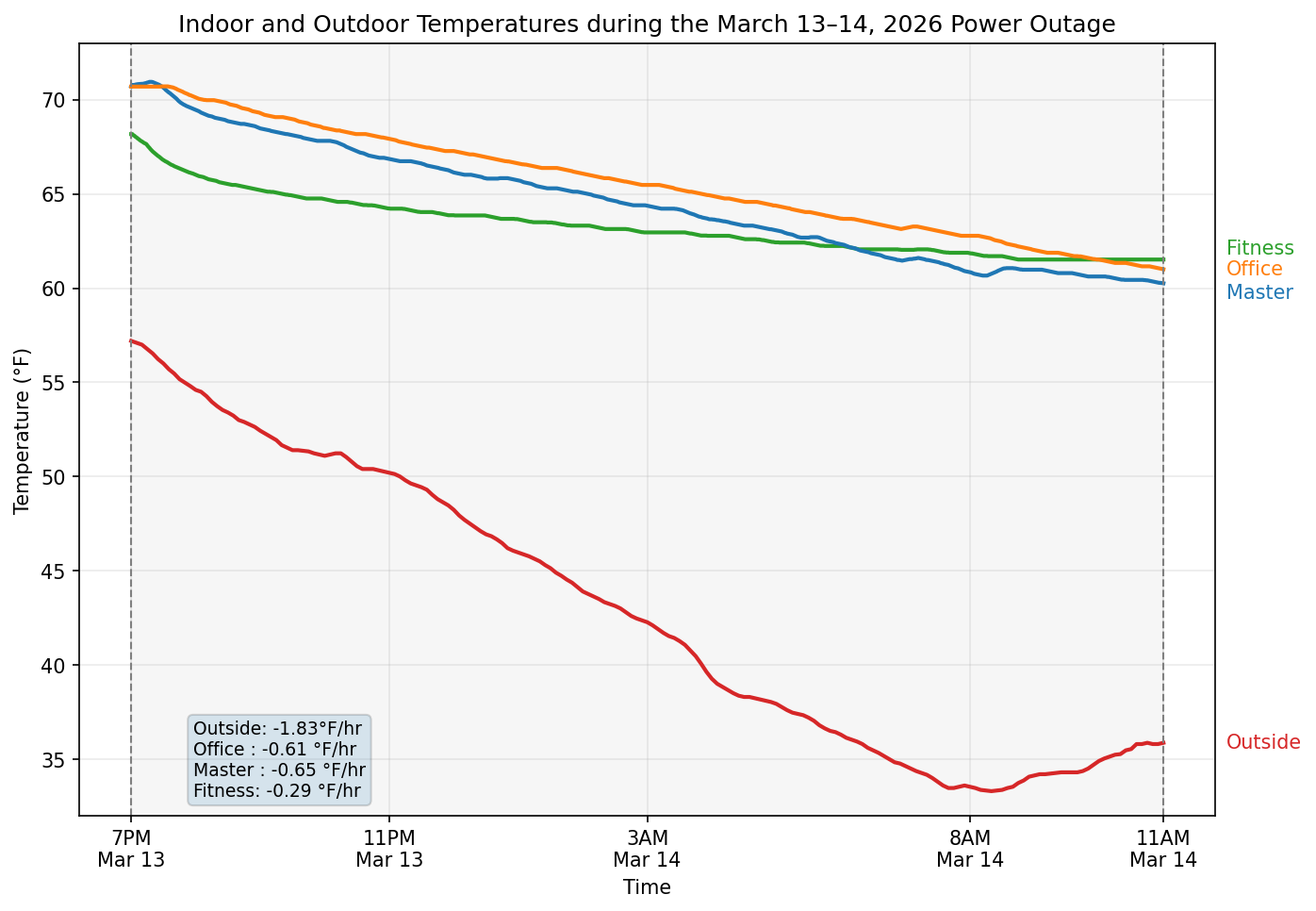
What I expected was a fast drop at first, slowing over time – like an exponential decay.
What I actually saw was a slow, straight-line decline. That turns out to be a good thing. It means we can stay in the house longer than I expected, if we make the right moves before an outage hits.
A Data-Based View of the Outage
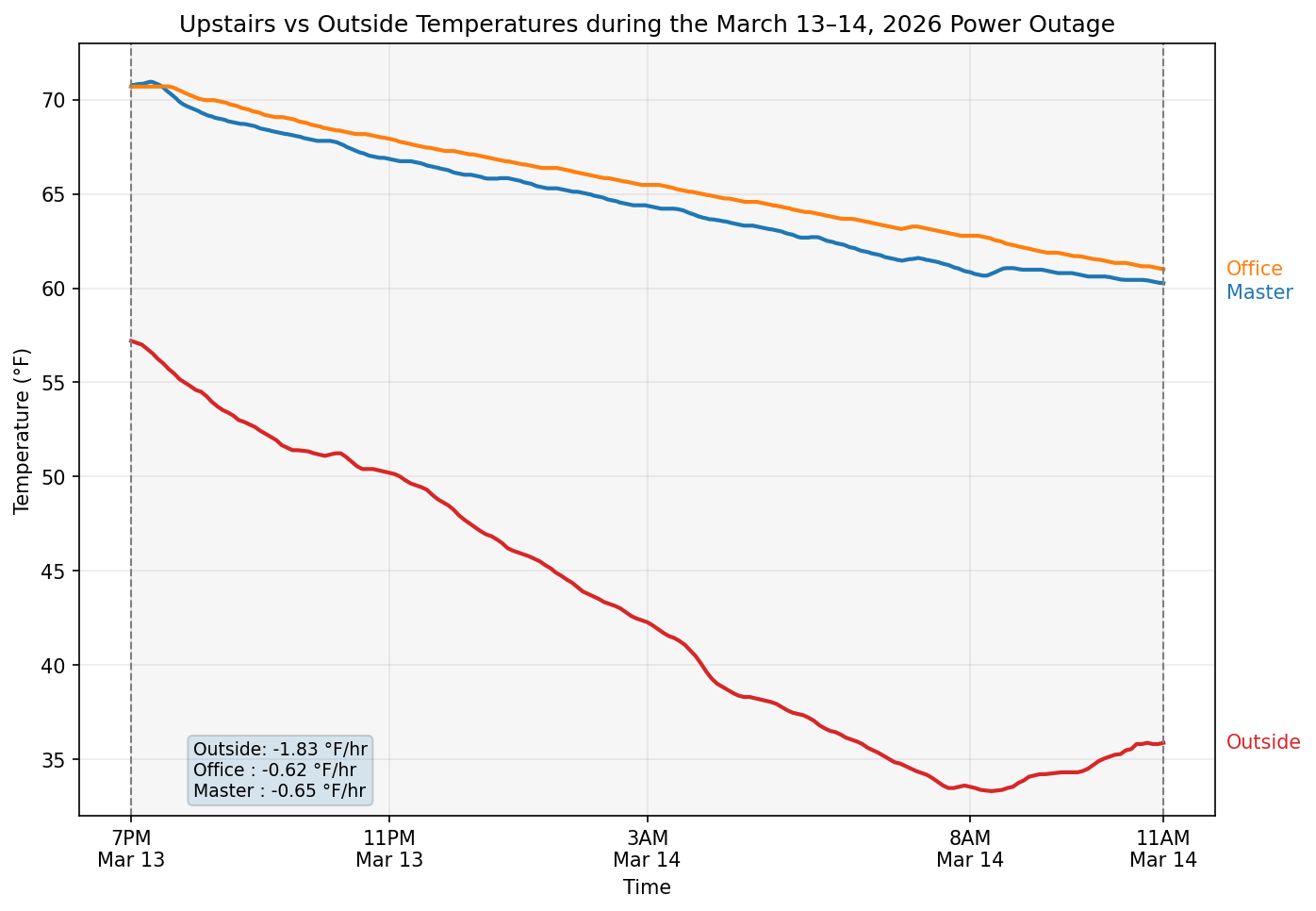
This outage occurred at near sunset and lasted almost 16 hours until power was restored the next morning. The outside temperature (the red line in the chart above) dropped 25 degrees during the darkness, or about 2 degrees each hour.
Inside it was a different story. Upstairs is our main living area. In the master bedroom and in my office (blue and orange lines above, resp.), the temperature dropped around 0.6°F per hour. That’s one-third the rate of the temperature decrease outdoors.
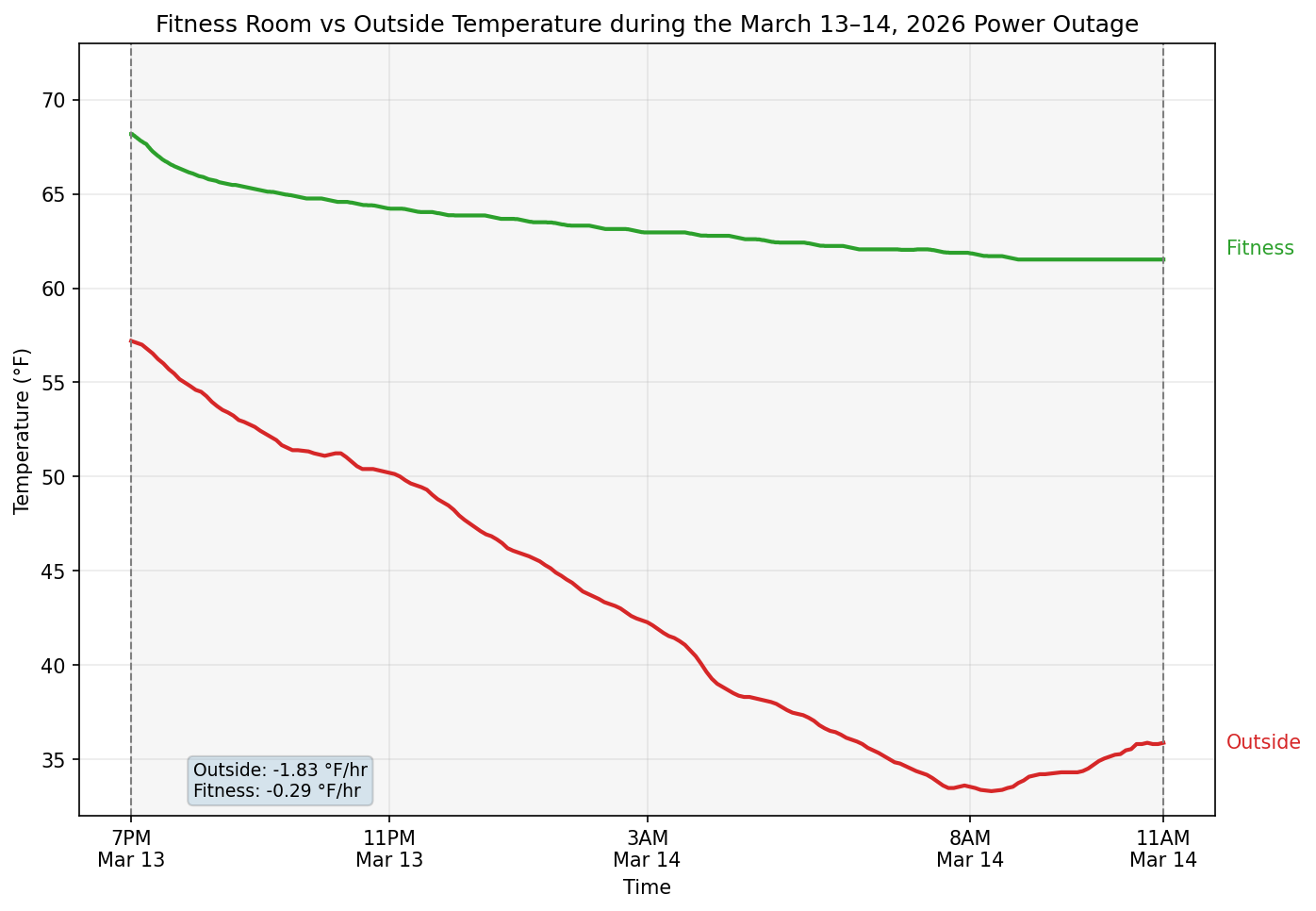
Downstairs, in our fitness room (green line in the chart above), the temperature dropped only 0.3°F per hour. That’s even slower than the decline seen in the upstairs rooms.
Why?
My working theory/guess is that the ground acts as a thermal “buffer”, insulating the fitness room (since, in our split-level home, it sits partly below ground level). I’ll need more outages to confirm this, of course, because there may be other factors at work, too. For example, the fitness room started at a lower temperature than the upstairs rooms.
What I Learned and What Surprised Me

I was surprised to learn that different parts of the house respond differently when we lose our heating capability. The behavior of these different “thermal zones” during a cold-weather power outage suggests a couple of memorable rules-of-thumb:
The temperature upstairs drops about two degrees in three hours, or eight degrees in half a day.
The temperature downstairs falls at half that rate: one degree in three hours, or four degrees in 12 hours. And we can take advantage of its “thermal inertia” (see below).
If we anticipate an outage, say the forecast calls for high winds, we should:
Bump up the thermostat setting to give us a longer “runway” of time before the house becomes too uncomfortable or unsafe. This seems obvious, but we haven’t been doing it. And since more than two-thirds of our outages last less than half a day, pre-warming to 75°F should keep us fairly comfortable.
Retreat downstairs if necessary during a lengthy outage. We can be comfortable there for a longer time since the fitness room temperature drops more slowly than it does upstairs.
Wrap Up
Now, I feel like I have much more clarity about our power outages. I know how much and how fast the indoor temperature actually changes – and how we can use that knowledge to stay safe and comfortable.
If you’ve got a smart thermostat and (get) a few temperature sensors1, you can prepare for your next outage and collect your own data. And if you do, I’d love to hear what you learn, especially if your experience differs from mine.
For sensing outdoor temperature, I use a Tempest personal weather station. Indoors, I have a handful of Govee temperature/humidity devices which are surprisingly capable. ↩︎