One of the joys of collecting your own data is choosing what, how, and why to visualize it.
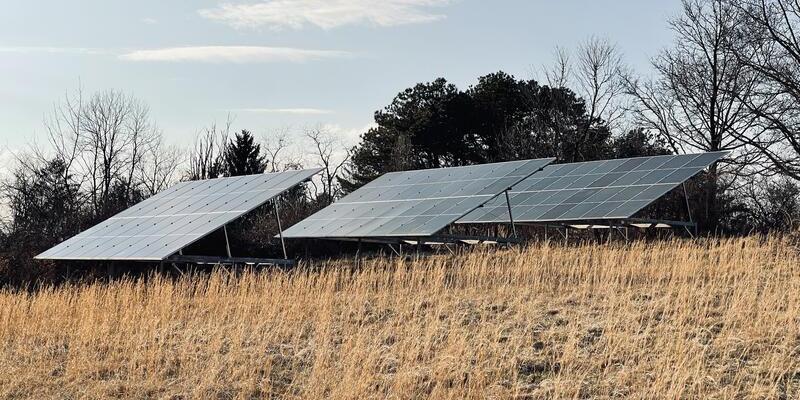
For our solar panel installation, every week I update a series of charts that I designed and built. Each visual answers a specific question and helps my wife and me monitor the health and performance of our panels.
Below, you’ll learn the questions I ask and the insights that I’ve gained. And I hope to inspire you to ask questions about your own personal data and build charts that really work for you – the way these work for me.
Question: How much electricity have we generated since day one?
This is the big picture.
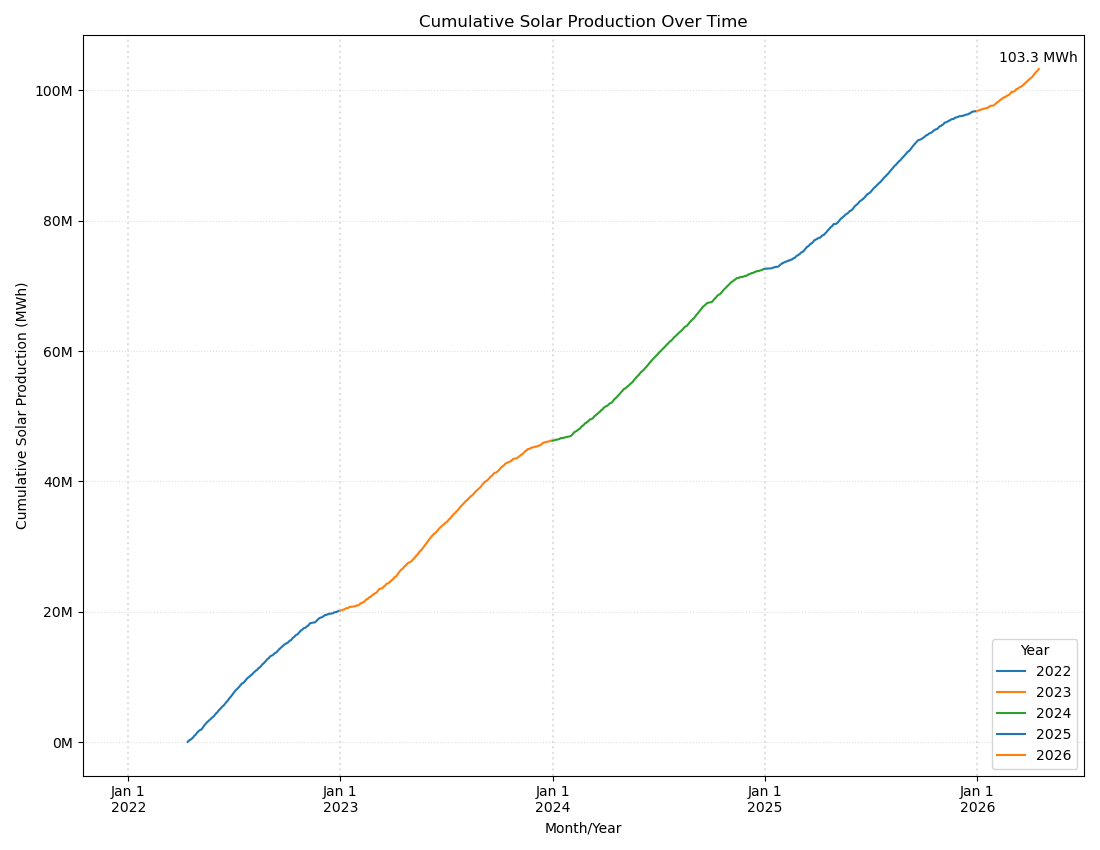
The number at the upper right tells us the lifetime production of the panels: 103.3 megawatt hours in four years. You could argue that the number is all you need to answer the question.
But I think seeing the yearly curves has value.
First, I love seeing that curve always moves upward (never discount the value of an upward trend as a motivator!).
Second, notice the elongated “S shape” of the curve for each year. The shallow slope at the start of the year becomes steeper through the spring and summer months, then declines again into fall and early winter. That’s the rhythm of our annual production. You don’t learn that from a single number.
Question: How does this year’s production-to-date compare to previous years?
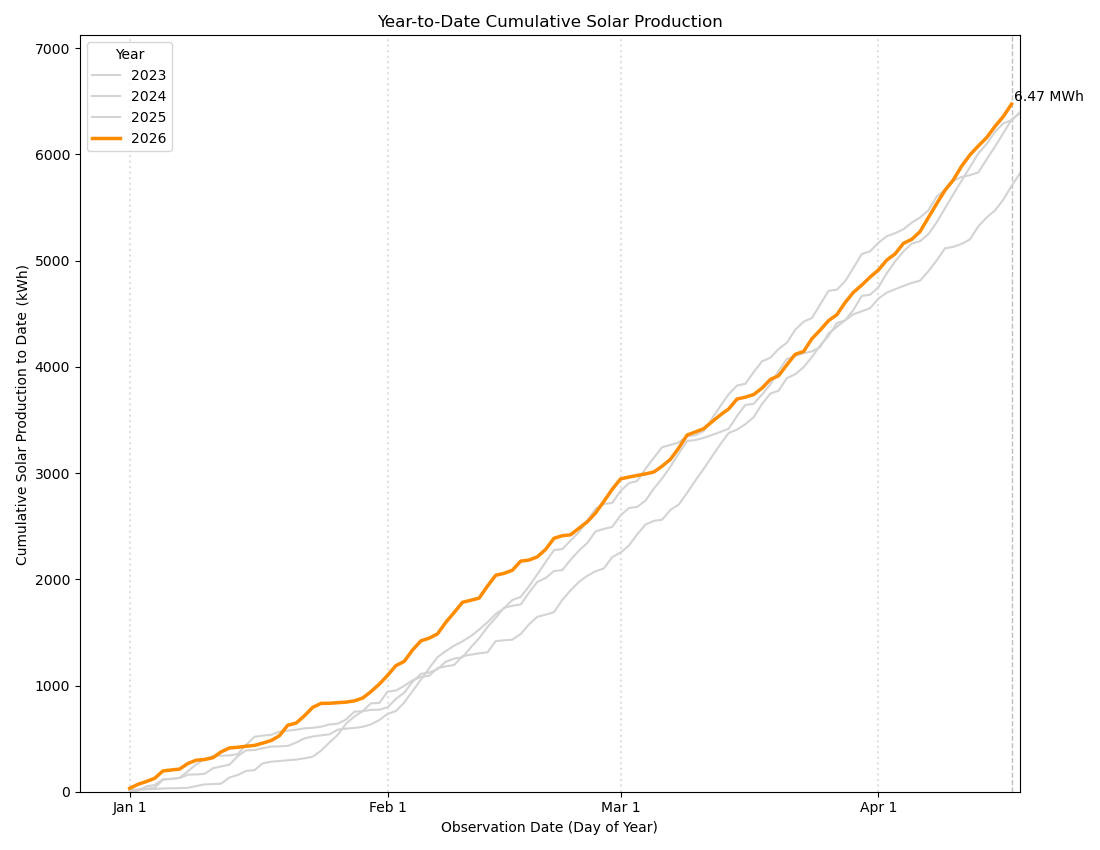
This year-to-date plot represents a snapshot of total production at a point in time: April 18, 2026. Notice that 2026 (orange line) is the best year at this date.
Slope equals performance: the steeper, the better. You can pick out days where the slope of the 2026 curve is nearly flat, which signals low production. Contrast those days with our best-producing days where the slope is steep.
You can also see the spread across years – as much as 800 kilowatt hours around March 1st. That’s good information about the variation in our production year-to-year.
Question: Month by month, how does this year’s production compare to previous years?
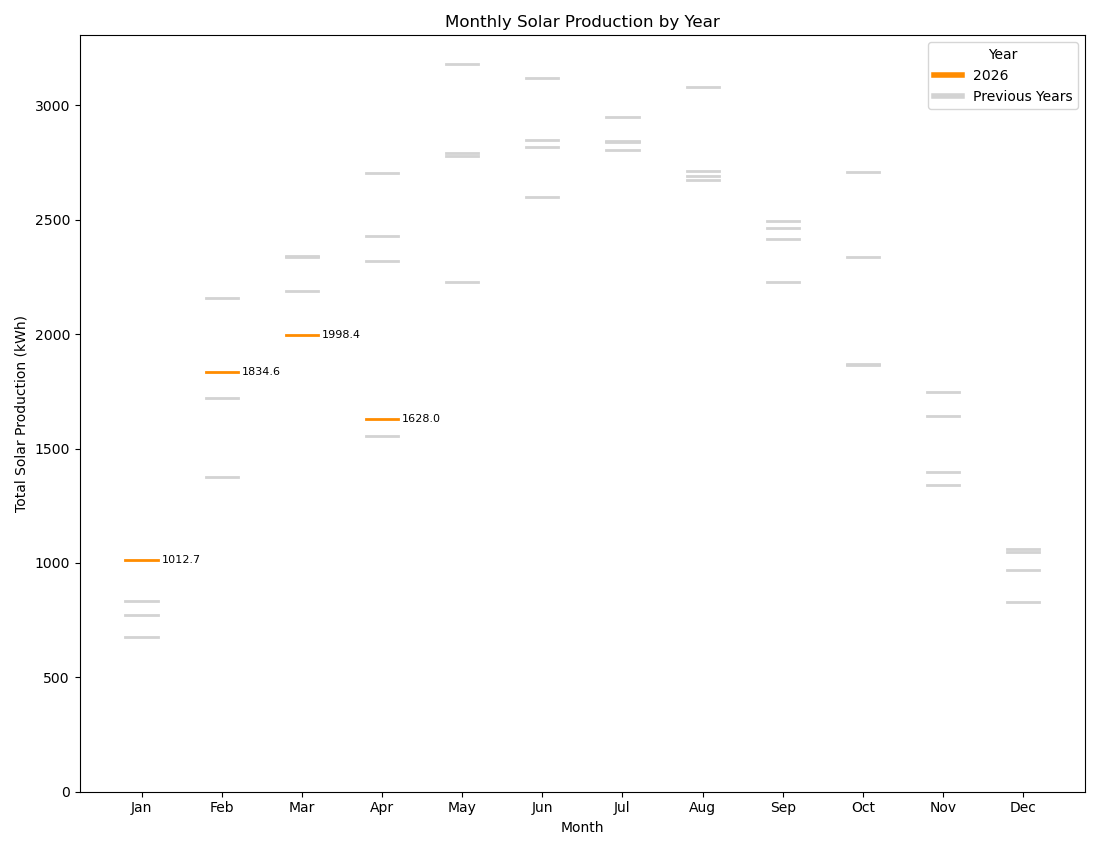
Each bar in this chart is a monthly production value. The current year appears in orange with values shown on the bars.
The overall “arch” pattern is clear: monthly production is largely driven by day length. Months with shorter days yield less than months with longer days. Duh. You would expect January to be different than July, but this plot tells you that they are a lot different:
- January median: 800 kilowatt hours
- July median: 2,800 kilowatt hours
That’s more than a 3X multiplier!
Another striking feature of this plot is the intra-month variation. For instance, the spread in May is nearly 1,000 kilowatt hours, which is the typical production for the entire month of January.
That’s why I think this monthly view is so valuable. Whether you’re charging an electric vehicle or living off-grid, use the monthly average for planning. The yearly average hides the significant month-to-month variation you see here.
Question: How much electricity did we produce each day?
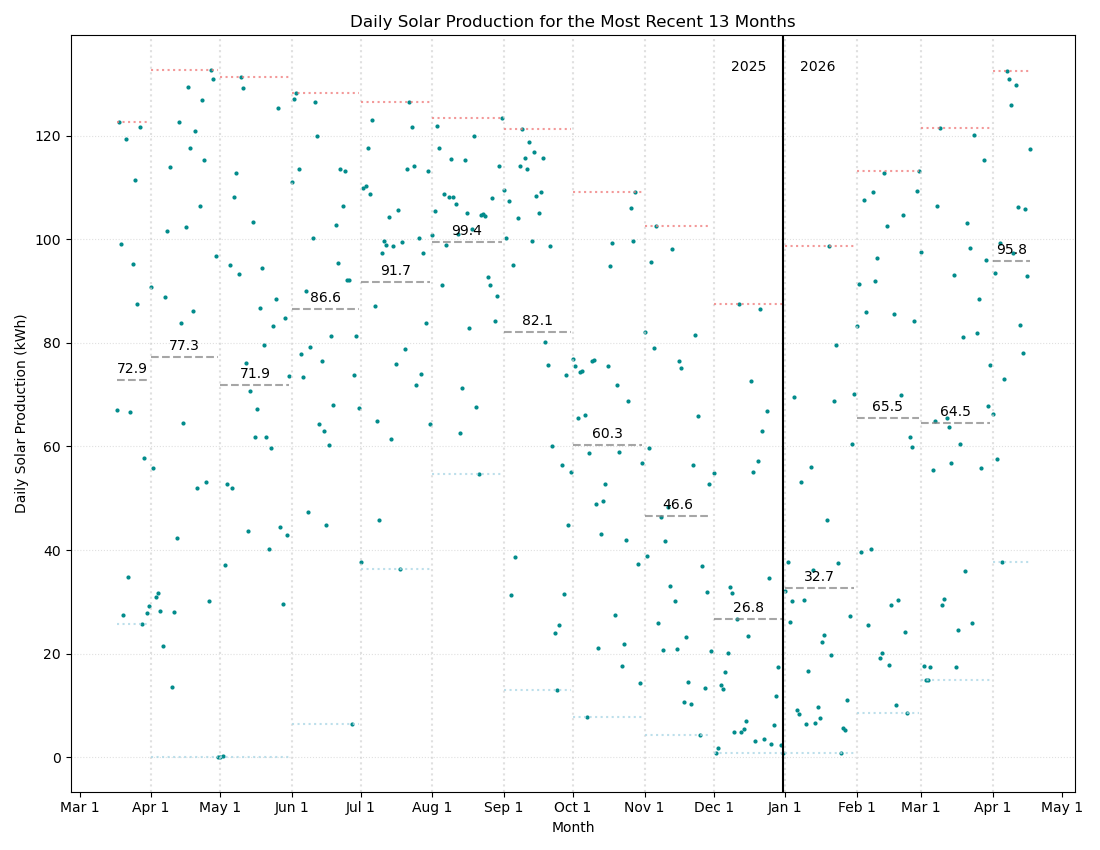
In this plot, each day is a dot. The monthly average is the dashed gray line, labeled with the value. The monthly min and max appear as dotted blue and red lines, respectively. The span is 13 months so you can compare the current month to the same month a year ago.
You’ll notice that I did not connect the daily dots, as is normally done for a time-series plot like this. I felt that the amount of day-to-day variation made the connecting lines obscure the data, and I am trying to follow Edward Tufte’s advice1:
“Above all else, show the data.”
The story here again revolves around variation – this time, day-to-day. On any given day, almost anything can happen. We can produce 100 kWh in January or 5 kWh in June. That’s life in rainy, cloudy western Pennsylvania. Your mileage may vary. Wildly.
Wrap-Up
The more personal data I collect, the more I learn the power of asking good questions. These charts provide answers to our specific questions about solar production, and they help us make timely decisions.
For example, the charts once enabled me to discover that an entire array of 16 panels wasn’t producing any electricity. I alerted our maintenance company before they alerted me. It was a technical glitch that was easily fixed, but we could have lost a lot of production, if we weren’t paying attention.
I’ve also learned the importance of visualizing data at different levels of granularity (lifetime, year-to-date, etc.). A lower level view (e.g., monthly) often helps me understand patterns that aren’t visible at a higher level (e.g., yearly).
Most of all, for me, visualizing is thinking. Maybe it is for you, too. It helps to make the intangible (data) tangible. So ask questions about your own personal data – and build visualizations to help you think through those questions.
To Go Deeper
See also:
- 4 Years, 100 MWh of Solar Power… in Pittsburgh?
- Is Our Solar Surplus Big Enough to Drive an EV for Free?
“The Visual Display of Quantitative Information: 2nd Edition”, Edward R. Tufte, Graphics Press, Cheshire, CT. ↩︎